Mango Basmati Rice

25 Jun

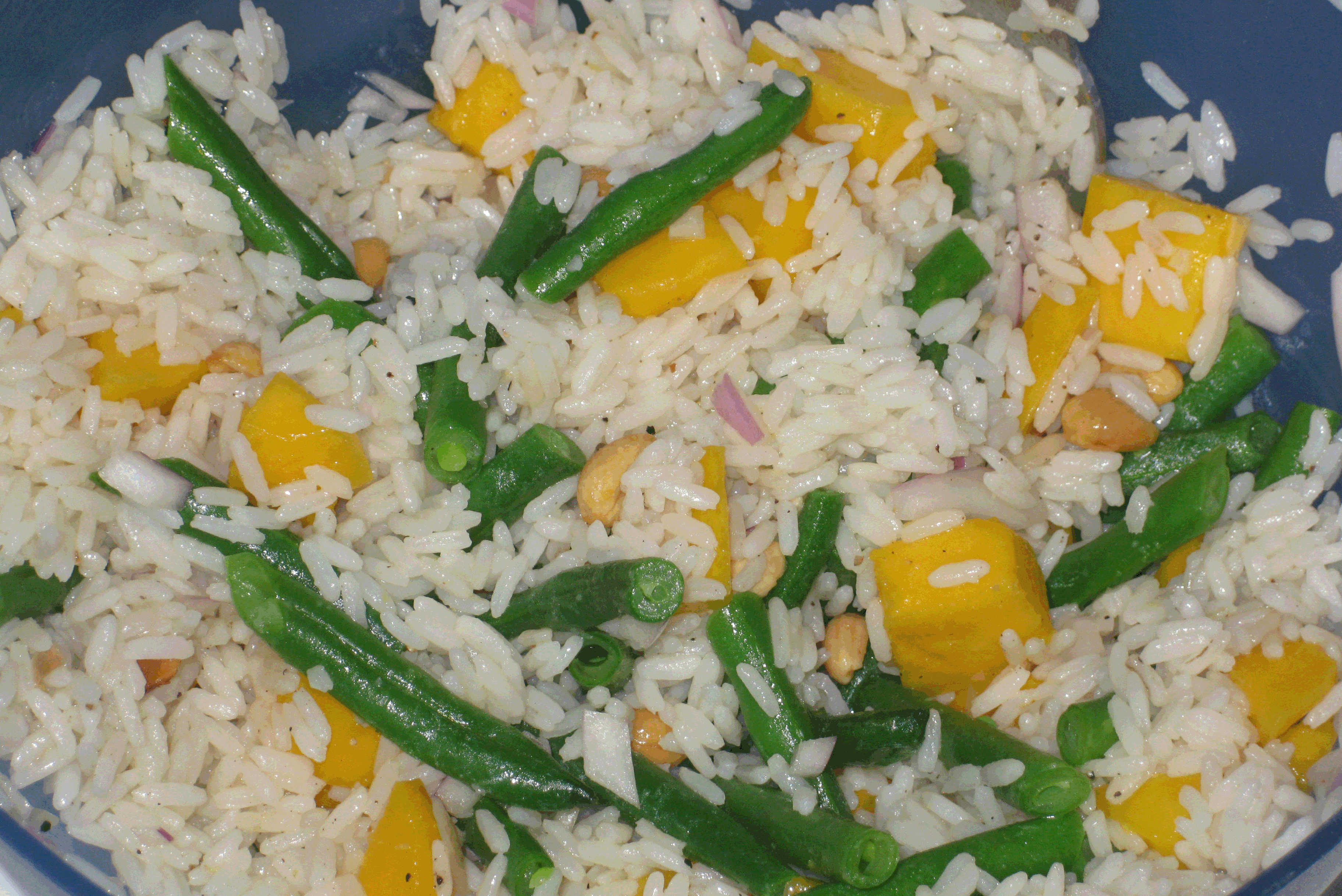
Let’s face it: rice is…well, it’s just rice. It’s not the most exciting ingredient. But what it lacks in flavour it makes up for in versatility, transforming from modest to extraordinary with a few extra steps. This is a modified version of Tyler Florence’s recipe: I used peanuts instead of cashews as that’s what I had around. He also calls for mint, but you could use cilantro or basil, too. I served this with lemon curry chicken, but it would go well with shrimp, pork or fish dishes.

Ingredients

1 c basmati rice
1 inch piece ginger, peeled and smashed w/ side of the knife
kosher salt
1/2 lb green beans
1/2 red onion, coarsely chopped
1/4 c cashews
1/4 c mint leaves, coarsely chopped
1 mango, peeled, pitted & chopped
2 tb extra virgin olive oil
1/2 lemon, juiced
black pepper

Directions

1. Put rice in a sauce pan with the ginger, 2 cups of water and 1 1/2 ts salt. Bring to a simmer over medium heat. Stir, turn down the heat, cover and cook 12 minutes. (If serving cold, spread the rice on a baking sheet and bring to room temperature.) Discard ginger.
2. Meanwhile, bring a pot of salted water to a boil for the beans. Fill a large bowl with ice water and add just enough salt so that you can taste it. Boil the beans for three minutes and then place them in the ice water for another minute or so to stop the cooking and maintain their bright green colour.
3. Place the mango, red onion, mint and cashews in a large bowl. Stir together with olive oil and season with salt and pepper. Add in the rice and beans, seasoning with the lemon juice. Re-season with salt & pepper if necessary.

National BBQ Day Media Launch

11 Jun

For the last few months, I have been working with the wonderful not-for-profit company, Meal Exchange. They are passionate about getting youth involved in the local food movement, working to alleviate hunger across Canada, but always with a local focus. I happen to believe strongly in their cause and, back in December 2011, I looked to get involved with them. Lo and behold, I came across National BBQ Day: an annual, Canada-wide event that encourages people to visit their local farmer’s markets, purchase some great food (steak, burgers, chicken, veggies, fruit…), throw it on the grill and then send in their photos for the chance to win some great prizes! I’m a big proponent of visiting a market instead of a grocery store whenever possible and I don’t know anyone who doesn’t love BBQ. Put these two together (with, again, a chance to win some great stuff) and you have a winning combination!

Meal Exchange has been very fortunate to partner with the incredible Chateau des Charmes, a stunning vineyard in Niagara-on-the-Lake. (Proceeds from the sale of each bottle of Generation Seven wine go toward Meal Exchange.) This beautiful spot was the location of this year’s media launch on Sunday, June 3rd.

BBQ-themed food stations were set up for patrons to enjoy with a wide variety of goods to sample. Matt Kantor, chef behind the Secret  Pickle Supper Club, presented three options: grilled Moroccan shrimp with chermoula & cilantro; lamb kofta with yogurt; and grilled dates stuffed with chorizo and served with a roasted pequillo sauce. I opted for the first and last and was not disappointed. The bacon-wrapped dates were especially good and, after watching him demonstrate how to make them, I will most certainly be trying these at home.

Moroccan shrimp

Bacon-wrapped dates

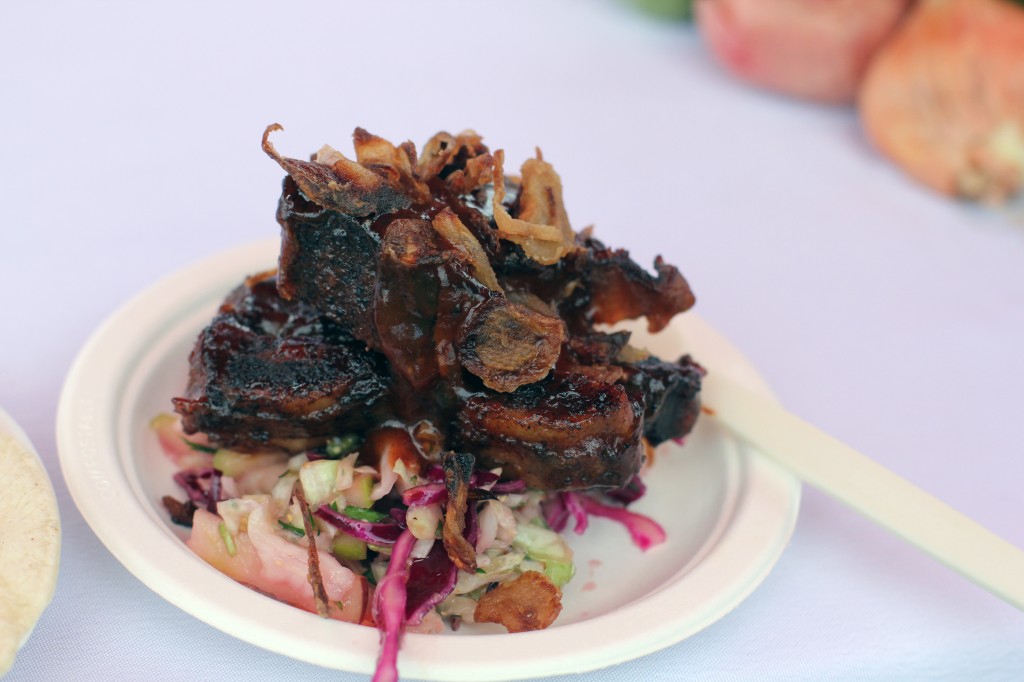
The Tide and Wine Oyster Company offered up a bevy over seafood treats, much to the delight of the people at the vineyard! Over on the other side, the Napoleon Grill chef Therese de Grace whipped up heaping portions of sticky, rich short ribs and and  tempeh tacos with tomatillos, vegan chipotle mayo, pico de gallo and shredded lettuce.  All of those plates were quickly – and happily – devoured.

Tim Tufts, the “master home griller,” created a stuffed pork tenderloin glazed with local whiskey and maple syrup, served with marinated and grilled asparagus. It was quite entertaining to watch Tim and his daughter cook and interact with the people there, demonstrating how to butterfly, tenderize and stuff the pork tenderloin. The stuffing contained mushrooms, bell peppers, breadcrumbs and red wine that had been cooked down and placed in the middle of the tenderloin.

Great food, great wine, great people all there for a great cause. Meal Exchange has been instrumental in helping so many across Canada and it was wonderful to see people out to support them. National BBQ Day is going to be a fantastic event –  if you haven’t yet, sign up to host or attend a BBQ of your own here!

Sauteed Vegetables with Soba Noodles

1 Jun

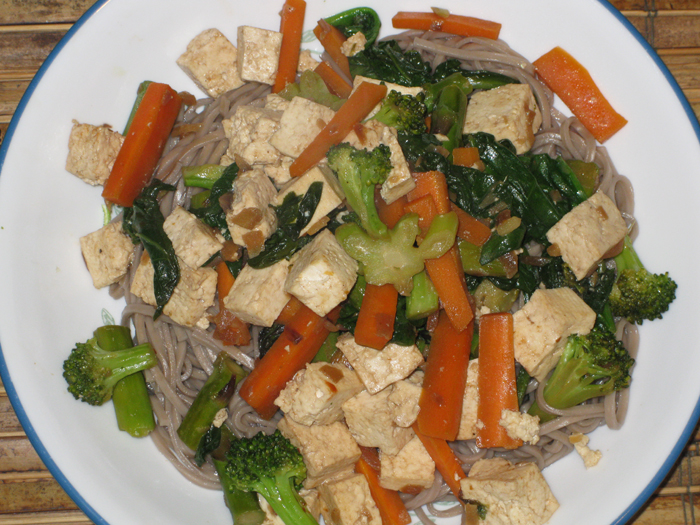
Currently, I am addicted to soba noodles. In truth, I love any kind of noodle (carb queen!) but these are my latest obsession. They’re easy to make and can be used in all sorts of dishes from salads to stir-frys. Last night, I went on a vegetarian tear, cutting up all sorts of spring veggies and some tofu for an Asian-flavoured dish with a soy-rice wine vinegar-hoisin-Sriracha sauce. If I’d had some mirin, I’d have used that, too, but I just grabbed what I had in the cupboards.

Serves 3 – 4

Ingredients

2 packages soba noodles, cooked
2 tb vegetable oil
1 2-inch piece of ginger, grated or finely diced
1 shallot, finely diced
4-5 stalks asparagus, ends trimmed, cut to bite-sized pieces
1 c broccoli
1 – 2 carrots, peeled and julienned
2 tb soy sauce
1 tb hoisin
1 1/2 c firm tofu, drained and cubed
4 – 5 handfuls of spinach leaves
1 c peas
2 tb rice wine vinegar
Sriracha to taste

Directions

1. In a large pan, heat the oil to medium heat. Add the ginger and shallot and sauté for 3 minutes.
2. Add the asparagus, broccoli and carrots along with the soy and hoisin. Sauté another 3-4 minutes.
3. Toss the spinach in next and allow to wilt a little before adding the tofu and peas. Salt and pepper to taste.
4. Add in the rice wine vinegar and Sriracha to taste.
5. Serve over the cooked soba noodles. Garnish with sesame seeds and scallions if you like!

The Art of Reading The Art of Eating

31 May

M.F.K. Fisher’s tome, The Art of Eating is an absolute classic. A compilation of the author’s five best-known works, Eating is made up of five works: Serve It Forth, Consider the Oyster,How to Cook a Wolf, The Gastronomical Me and An Alphabet for Gourmets. This particular edition is the 50th anniversary and it was great to be able to read all these wonderful, evocative, fascinating, funny, sad and drool-inducing books all in one place. Each book is different, consisting of a variety of writing styles and themes. Some feature short essays on different food-related topics (oysters, dinner at her favourite restaurant, eating in medieval times, cabbage, etc.), while another relates the story of cooking during the very difficult years of World War II. I have read and enjoyed snippets of Fisher’s writing before but I am now totally hooked on it. The books made me want to rush into the kitchen or out to the restaurants but, most importantly, they made me appreciate food on a deeper level.

As a side note, I found that it is best to mind the following steps before, during or after embarking upon reading this massive collection of work:

Step 1: find yourself a comfortable spot. Perhaps curled up on the couch, listening to the rain or basking in the sunshine. You’re going to be there for a while. If at all possible, have a glass of wine handy. (Perhaps keeping the bottle nearby would be for the best.)
Step 2: position yourself near a food source. This might be near your kitchen, in a coffee shop, in a restaurant. Any or all will work.
Step 3: cancel your plans for the night, unless they involve dinner. And wine.
Step 4: book your ticket to France now. You’re going to want to go.

Cochinita Pibil (Slow-Roasted Pork)

23 May

This one is all on Eat St. I was at home watching it and one of the food trucks had their version of cochinita pibil, a traditional Mexican shredded pork dish. For me, shopping for the ingredients was as much fun as making it. I headed off to Wychwood Barns on Saturday to get the pork from my fave farmers at Marvellous Edibles. (Best. Bacon. Ever. Go try it, people.)  Then it was off to St. Clair West to La Tortilleria for fresh tortillas and the achiote paste. It is imperative that you not substitute the achiote paste for anything else:  it is the dominant flavour in the dish. If you can get your hands on banana leaves, so much the better as the pork is traditionally cooked in them. Having said that, foil will work.

Best to get this started the day before you want to cook it. The pork should marinate in the fridge for 6-24 hours, but no more than 24 hours as the enzymes in the citrus juices will break down the meat too far and give it an unpleasant texture. It also takes 3 – 4 hours to cook, so ensure you’ve left yourself enough time to cook it!

Serves 4.

Ingredients

3lb pork shoulder, cut into 2″ pieces (do not trim fat)
1c orange juice
1/2c lime juice, (4-5 limes)
1 ts salt
3 oz of red achiote paste (also called “annato paste”)
Pickled red onions (optional), for garnish
1c cilantro, chopped, for garnish
Lime wedges, for garnish

Directions

1. Blend together the paste, salt, orange and lime juices in a blender. (Make sure you rinse out your blender quickly as the paste will stain.) In a non-reactive bowl, combine the marinade and the pork pieces. Mix well, cover and refrigerate for 6 – 24 hours.
2. Preheat the oven to 325°F. Line a large casserole with a triple layer of regular foil – you want a good seal. Pour in the pork and the marinade and close the foil tightly. Put the casserole in the oven and bake 3.5 hours. At this point, remove from the oven and check to see if the meat is falling apart. If so, you’re done! If you think it could use a little more time, put it back in for 30 minutes.
3. When the pork is tender, take it out of the oven and open the foil. Remove the meat with a slotted spoon to a bowl, then shred it with two forks.  If necessary, pour some of the remaining sauce over the pork to make sure it’s juicy.
4. Serve with either fresh tortillas or rice. For garnish, add lime wedges, cheese, avocado, cilantro and/or pickled onions.

This slideshow requires JavaScript.

Pickled Red Onions

23 May

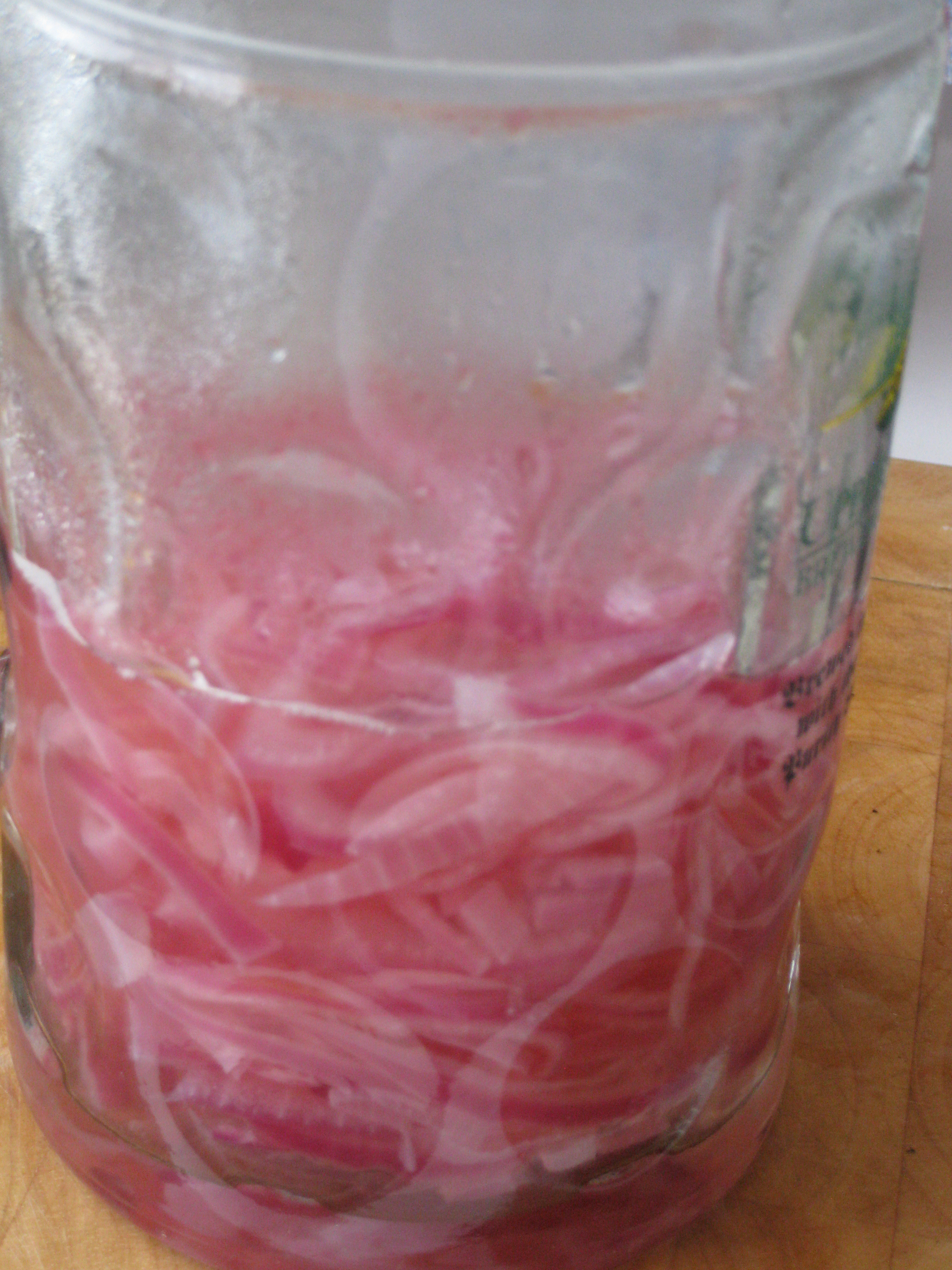
As a mini-project over the long weekend, I decided to make pickled red onions. I’m sure I could have bought them, but we happen to have a surplus of them at home so it made a lot more sense just to make my own…especially when I discovered how easy it is! The onions turn bright pink and become crunchy as they cool. They keep in the fridge for a couple of weeks and can be used in a wide variety of dishes!

Ingredients

1 red onion, sliced as thinly as possible
1/2 c cider vinegar
1/2 ts salt

Directions

1. In a small pot, blanch the onion slices for 1 minute in boiling water. Strain.
2. Place the onion back in the pot with the vinegar, salt and just enough cold water to cover everything.
3. Bring to a boil and cook 1 more minute.
4. Place the entire mixture (brine and onions) into a glass container and chill.

Braised & Curried Tofu in Coconut Milk

14 May

A few months ago, we decided to implement Meatless Mondays at our place. We already had a good variety of Latin American recipes from which to pick that were vegetarian but after a couple of months, we’d pretty thoroughly exhausted them and wanted to try something new. I really enjoy coconut curry but hadn’t tried many – okay, any – recipes with tofu. J came across this recipe and made it with much success. The original recipe did not call for the soy sauce, but I would certainly recommend you use it.

Ingredients

1 16oz carton of firm tofu, packed in water
1 tb vegetable oil
1 yellow onion, thinly sliced
3 garlic cloves, finely chopped
1 tb ginger, finely chopped
1 15oz can coconut milk
1 ts Thai curry paste (or to taste)
1 ts soy sauce
1 ts hot sauce, optional
1/2 ts salt
3 tb cilantro stems, chopped + leaves for garnish
1 c frozen peas
Juice of 1 lime
4 c cooked rice
2 tb roasted peanuts or cashews, optional

Directions

1. Drain tofu and set on a cutting board while you assemble the rest of the ingredients.
2. Heat the oil in a sauté pan. Add onion, cooking over medium-low heat, stirring occasionally, until translucent, 3-4 minutes. Stir in garlic and ginger; add coconut milk, curry paste, salt, soy sauce and cilantro stems. Simmer gently. (If you’re using the hot sauce, add it here.)
3. Cut tofu into cubes or triangles. Add to sauce, raising heat to medium. Cook until heated through, approximately 5 minutes. Add peas and cook for a few minutes until hot. Season with lime juice.
4. Serve tofu and sauce over rice and garnish with roasted nuts and reserved cilantro leaves.

My Epic Meal at Centro

10 May

In the last couple of months, J has become friends with one of the wait staff at Centro. Trevor has been insisting that we come in one night to check it out; that we were missing out on a great dinner; that we’d be well taken care of. After a few weeks, we decided we had nothing to lose (except the ability to fit into our pants, apparently) and made a date to check it out.

We walked into the high-ceilinged, heavily-mirrored dining room and were appropriately agog. The room manages to be at once cozy and grandiose. We were shown to a corner table with tall banquette seating with a great view of the dining room. We watched the waiters practically dance around the tables, expertly serving their well-attired clientele. Trevor greeted us, took our drink orders and told us to sit back and relax. Since we’d be having the chef’s tasting menu, all decisions were out of our hands which was just fine by us. My only request was no olives, please. (I have a well-documented hatred of them. I have tried them a few times and I just. Can’t. Do it.) Three hours and seven courses later, we walked out two happy and very full customers.

Two separate starters arrived at our table to begin: piping hot arancini stuffed with pesto risotto and buffala mozzarella, sitting on tomato chutney and a beautiful charcuterie plate with boar salami, guanciale, prosciutto, pate, rye crostini and pickled vegetables. Both plates were stunning to look at and had our mouths watering for more. Following the opening dishes were colourful plates of pickled beets topped with that same creamy buffala mozzarella, pesto and light, crunchy bread tuiles. Light and refreshing, this was a great follow-up to the heavier course before it.

Two courses down, five to go. (Not that we knew how many courses were headed our way. Just that we were going to eat. And eat. And eat.) Next up was perhaps the most delicious scallop dish I have ever had. A single seared scallop in a Meyer lemon sauce, topped with capers and brioche crumbs. Incredible. The sweetness of the scallop was offset – but not overwhelmed – by the briny capers, sharp lemon sauce and the crunch from the bread all came together in a few perfect bites.

The fourth plate? Oh my. This was a gorgeous, rich braised short rib and maple-glazed sweetbreads with crispy leeks, a sunchoke purée and a red wine gastrique. Rich, unctuous, sweet…heaven on a plate. The sweetbreads were absolutely delectable – even J, who was a bit dubious initially, absolutely loved them. They were nice and crispy on the outside and tender on the inside, just as they should be. Folks, if you want to try something a little different, I can’t recommend these enough. Chef Symon Abad knows how to handle ’em.

Around this point in the meal – about an hour and a half in – I am thanking all sorts of gods and monsters for not having worn a belt. No one plate was huge, but they were starting to add up. The short rib was wonderfully fatty (not overly, though) and rich. I was thinking that there couldn’t be much more. Like, maybe dessert next? J suggested that there might be pasta on the way, but I just didn’t think that was going to happen. That is, until bowls and seafood forks arrived. Okay. So this was not dessert coming up. No, in fact, it was a lovely pasta course (score one for J!) of squid ink fazzoletti (“handkerchief” in Italian) served with crab, mussels, clams and shrimp in roasted garlic and red pepper sauce. Yes, you read that right. An impressive dish on an impressive evening.

“Okay, that’s got to be it, right? We’ve had meat, pasta, seafood…that’s gotta be it.” I exclaimed. Trevor and another waiter came and cleared away everything but our glasses from the table and I figured that could only mean one thing: dessert.

Trevor: “Okay, folks! Just a main and a dessert to go!” *laughs and walks away*
J: “Did he just say a main?”
Me: “Nahhh, he’s gotta be kidding! I mean, we have no cutlery, no side plates, and he laughed! I’m sure he was just kidding.”

Ten minutes later, forks and sharp knives were placed in front of us. Dear god. Trevor was nearly giddy as he placed veal tenderloin and calf’s liver on potato rosti, red cabbage and pearl onions in front of us as our eyes widened. “Your mains!” he proclaimed. As full as I was, there was simply no way I was not going to try this. The tenderloin was seared on the outside, juicy and just a little pink on the inside. Excellent. I could have eaten four pounds of the potato rosti it was so good. Unfortunately, I’d pretty much hit my wall. I could not have eaten another bite of this rich, tasty plate. J fared better than I but still couldn’t finish. We didn’t want to waste anything so we had what remained packed up.

We paid a quick visit to the chef and his brigade to thank them for a fantastic meal. It was nice to, you know, stand up. Maybe we should’ve gone for a walk around the block between courses!

And what arrived for the seventh and final course of the evening? Two different dishes: a lovely, light, layered cake with rhubarb filling and a plate with freshly-made mini-donuts dipped in maple sugar and served with squash-maple purée and crème fraiche ice cream. Oh my. A fabulous way to end an extraordinary meal. We sat, mildly dazed, sipping ginger tea for a little while, watching the staff clean up for the night, contemplating the past three hours of food extravaganza. A beautiful meal in a beautiful place. The pedigree of chef that’s come through Centro is of the highest quality (Marc Thuet, Michael Bonacini, Chris McDonald…it goes on) and chef Abad upholds the restaurant’s stellar reputation.

Spotlight Series: La Cascina

8 May

This is the first in a series of monthly posts about some of my favourite smaller spots in Toronto.  I love getting to know the people behind the great food we have in this city!

When people ask me, “What’s your favourite restaurant in the city?” my answer is, invariably, La Cascina. Since popping in a couple of years ago for what turned out to be a delicious, filling, relaxing, and surprising meal, J and I have been going back more and more frequently. It’s our go-to for a nice meal. We know we will be treated well by the staff who cater to their guests’ needs without being obsequious nor pushy. It’s the kind of place you go on a date, for a birthday dinner, with family or friends to linger over wonderful Italian food and wine.  Recently, I had the chance to sit down and chat with chef Luca and front-of-house manager, Sharifa, to discuss Abruzzo, Toronto and many things in between.

Having owned a restaurant of the same name in the Abruzzo, when chef Luca arrived in Toronto he was disheartened to see that the hospitality he worked so hard to achieve back home didn’t really exist here. He found dinner here to be a standard, two-hour maximum affair, with restaurants more concerned with flipping tables than satisfying customers. “In Italy, eating is a passion. We had a ‘destination’ restaurant: people would drive for two hours, arriving in the afternoon for lunch and staying through dinner.” With 15 years in the kitchen under his belt and yearning to recreate this kind of atmosphere, Luca opened a restaurant in Woodbridge with much success. As they are in the current location at Avenue & Lawrence, patrons are allowed to take their time with their meals, enjoying every last bite.

Of course, a welcoming atmosphere isn’t worth much if the food is mediocre or even average. Always striving for authentic Abruzese food, Luca vehemently explains, “You will not find veal parmigiana or fettucine alfredo on the menu. Customers sometimes would ask and we would have to explain that we don’t do that here. We have to educate them. It was hard in the beginning but we are winning people’s trust.”

What will diners find on the menu? An ever-changing array of beautiful dishes. Cold antipasti platters of cured meats and young cheese; hot bowls of farro, of braised fennel with onions, of roasted zucchini and almonds. Any pasta option they choose will be made to order and will be incredible. There is always at least one meat and fish option and once a month, Luca and Sharifa host a fish and seafood evening (i sapori del mare). These nights feature succulent, well-executed dishes like rich arctic char topped with truffles and briny linguine vongole.

I asked Luca what his favourite dish to cook was and it happened to coincide with the first dish he learned to make: pasta carbonara. He spent much time trying to perfect it when he was younger and, as he spoke about it, you could see the passion in his eyes. Already a pretty animated person, he was practically giddy when explaining that what you really needed is a few key elements of the highest quality. It’s not a difficult dish to create; but, to make it excellent, you have to have the best, the freshest, ingredients. “You don’t need cream. There is no cream in this restaurant because people in Abruzzo would never use cream. You just have to make it right.” Indeed – and he does. I had some that night and subsequently told all my friends about it. I returned two weeks later with a girlfriend and it happened to be on the menu. She is not a huge fan of pasta, but my effusive praise had convinced her that she had to try it. We split an order and the look on her face was one I recognized: pure food-induced happiness.

A question I love to ask people – especially chefs – is the old, “If you were stuck on a desert island, what five ingredients would you want to have with you?” The chef rhymed off the first three in rapid succession: “pasta, bread and eggs.” After a little further thought, he added truffles and lamb. I, for one, wouldn’t mind being stuck on that desert island if he were there to cook all those things for me.

I encourage you all to come to this wonderful restaurant. There is always something new to experience and Sharifa & Luca constantly strive to bring more to the customer. They are budding sommeliers and stock some lovely Italian wines. (A personal favourite of mine is the Nicola Di Sipio Montepulciano 2008.) Come for the atmosphere: meet Sharifa, the ever-gracious and knowledgeable manager. Come for the friendly and warm service. Last but certainly not least, come for the simple but remarkable food. It’s going to make you re-evaluate the other Italian restaurants at which you’ve been eating and may well spoil them for you.

Glazed Pork Loin with Pineapple Chutney

1 May

Surfing around the internets, I landed on this recipe and was enticed by two of my favourite ingredients: pork ‘n’ pineapple. I added a little more cayenne to the chutney as I like things a little spicier. Also, if you’re a bit short on time, you can skip buying a whole pineapple and cutting it up, you could get one that has already been peeled. I wouldn’t recommend getting the canned stuff, but that’s a personal preference and will certainly do in a pinch. Start this baby about 3 hours before you want to eat as it needs some time to marinate. It’s time well spent!

Ingredients

2 large cloves garlic
Kosher salt
1 tb extra virgin olive oil
2 ts finely grated lemon zest
1 1/2  ts ground coriander
1 3lb boneless pork loin roast
1 medium fresh pineapple (about 3-1/2 lb.)
1/4 c maple syrup
2 tb sherry vinegar
1 large shallot, minced
Pinch ground cayenne  -or more to taste
1 large scallion, thinly sliced, white and green parts separated
3 tb chopped fresh cilantro

Directions

1. Peel and coarsely chop the garlic. Sprinkle with a generous pinch of salt and mash it into a paste with the side of your knife. Transfer to a small bowl and stir in the oil, lemon zest, coriander & 1 tb salt.
2. Put the pork on a large rimmed, foil-lined baking sheet, pat dry with paper towels, and rub all over with the salt mixture. Let sit at room temperature for at least 1 hour, no more than 2.
3. Position a rack in the center of the oven and heat the oven to 350°F. Roast the pork until an instant-read thermometer inserted in the thickest part reads 130°F, roughly 50 minutes.
4. Meanwhile, peel and core the pineapple. Cut half into small dice and roughly chop the other half. Purée the roughly chopped pineapple in a blender, then strain it through a fine strainer, pressing on the solids with a spoon. This should give you about 3/4 cup juice which goes into a small saucepan with the maple syrup. Cook over medium-high heat until reduced to 1/3 cup, 12 to 15 minutes. (The liquid will become very bubbly as it reduces; lower the heat as necessary so nothing burns.)
5. Set aside all but 2 tb of the reduced liquid as this will be your glaze. Add the vinegar, shallot, cayenne, and a pinch of salt to the 2 tb liquid remaining in the saucepan and cook over medium heat just until the shallot begins to soften, about 2 minutes. Add the diced pineapple and scallion whites. Cook, stirring frequently, until the pineapple softens and releases some of its juice, 3 to 5 minutes. Remove from the heat and let cool slightly.
6. When the pork reaches 130°F, brush it with some of the glaze and continue to roast, brushing with more glaze every 5 minutes, until an instant-read thermometer inserted in the center of the roast reads 145°F, about 15-20 minutes more. Let rest for at least 15 minutes before serving.
7. When ready to serve, stir the scallion greens and cilantro into the chutney. Slice the pork into 1/2-inch-thick rounds and serve with the chutney.

This slideshow requires JavaScript.